Industrial cargo securement leaves no room for error. Failed strapping leads to damaged goods, safety hazards, and severe liability during transit. Procurement managers face a significant challenge due to the variability in manufacturing standards across global suppliers. Buyers often struggle to differentiate between high-tenacity polyester straps and substandard alternatives that stretch, fray, or snap under dynamic loads. When a flatbed trailer hits the highway or a shipping container is loaded onto a vessel, the securement system takes the full force of every bump, turn, and sudden stop. You need materials that hold tension reliably. This guide provides a structured evaluation framework. We will help you assess technical specifications, verify testing documentation, and select a reliable manufacturing partner for bulk orders. You will learn exactly what separates field-ready strapping from cheap imitations.
System Strength vs. Linear Strength: The true holding power depends on the synergy between the strap and the buckle, not just the strap alone.
Hardware Compatibility is Non-Negotiable: Using mismatched hardware (e.g., pairing heavy-duty straps with low-quality buckles) compromises the entire securement system.
Documentation is Proof: Legitimate suppliers will readily provide verifiable composite strap testing documentation and hold active ISO certifications.
Defining Success Criteria for Cargo Securement Systems
Load Capacity, Low Stretch, and Dynamic Tension Requirements
Static load capacity only measures resting weight. Cargo securement requires dynamic shock absorption. Transit via rail, sea, or road subjects loads to violent shifts. Sudden braking creates massive forward momentum. Rail shunting introduces extreme impact forces. Continuous rolling on ocean vessels stresses the securement system repeatedly. You cannot rely on static numbers when the real world applies dynamic force.
Baseline tensile strength requirements vary by industrial application. Standard palletizing requires moderate strength. Heavy-duty composite systems can reach or exceed 3,000 kg in system strength. This capacity secures heavy machinery, steel pipes, and timber bundles effectively. When you evaluate a strap, you must look at how it handles sudden spikes in tension.
Low stretch properties are non-negotiable. High-tenacity polyester must retain tension throughout the journey. Excessive elongation allows cargo to shift. Shifting cargo breaks center of gravity calculations. This leads to overturned trailers or damaged shipping containers. Quality straps possess elastic memory. They absorb sudden shocks and immediately return to their original tension state. If a strap stretches and stays stretched, the load becomes loose. Loose loads destroy themselves from the inside out.
Environmental and Weather Resistance
Industrial environments expose cargo to harsh elements. Robust polymer coatings protect the internal polyester yarn. This coating blocks UV degradation during outdoor storage. It prevents moisture ingress during sea freight. It also shields the load-bearing yarns from chemical exposure in industrial yards. Uncoated fibers soak up water, freeze, and snap.
Temperature fluctuations directly impact strap tension. Extreme cold makes inferior plastics brittle. High heat causes cheap polymers to soften and stretch. High-quality composite cord straps maintain structural integrity across diverse climates. Unlike steel banding, they do not rust. Unlike natural fibers, they do not rot. This weather resistance ensures the tension applied at the loading dock remains constant upon delivery. You can store these straps outside in a lumber yard or ship them across the ocean without worrying about material degradation.
Technical Specifications to Verify Before Ordering Wholesale Composite Cord Strapping
Polymer Coating and High-Tenacity Polyester Yarn Quality
Understanding the anatomy of a composite strap is mandatory for buyers. The core consists of parallel high-tenacity polyester yarns. A clear polypropylene coating encases these yarns. The yarn provides the tensile strength. The coating provides rigidity and protection. The manufacturing process extrudes the hot polymer directly over the tensioned yarns, creating a unified band.
Composite straps differ significantly from uncoated woven or lashing straps. The polymer jacket delivers superior abrasion resistance. This prevents the strap from fraying against sharp pallet edges or rough cargo surfaces. The rigidity of the coating also allows operators to feed the strap under pallets quickly without it folding or catching. Woven straps often bunch up or snag on splinters.
Inspect physical samples for consistent coating thickness. Uneven coatings indicate poor extrusion control. Verify yarn alignment within the jacket. Yarns must remain perfectly parallel. Twisted or exposed yarns create weak points. Exposed yarns lead directly to abrasion failure during transit. You can perform a simple visual check: hold the strap up to the light. The yarns should look uniform, with no gaps or overlapping threads.
Sizing and Application Fit: Evaluating 16mm Composite Cord Strap
The industry standard for many applications is the 16mm composite cord strap. This width provides an ideal balance of strength and flexibility. It handles medium-to-heavy loads efficiently. Common use cases include securing chemical drums, palletizing construction materials, and bundling metal extrusions. It fits easily into standard tensioning tools and works well with standard corner protectors. A 16mm strap is often paired with a 3.5mm or 4.0mm wire buckle. When securing 55-gallon steel drums to a standard wooden pallet, operators typically use two bands running horizontally and two bands running vertically. This grid pattern distributes the dynamic load evenly.
Evaluate the elongation and recovery rates specific to this 16mm width. A quality strap will elongate slightly under peak dynamic stress to absorb the shock, then recover its tension. Inferior straps stretch and remain slack. You want an elongation rate of around 8% to 10% at break. Anything higher means the strap will loosen during transit.
Specify correct coil lengths when ordering wholesale composite cord strapping. Straps that are too short for standard loads cause severe issues. Operators may attempt dangerous splicing techniques to extend the length. Splicing compromises the system strength entirely. Standardized coil lengths prevent material waste and ensure safe, continuous securement loops. Check the meterage on the coil label and verify it matches your purchase order.
Hardware Compatibility and System Synergy
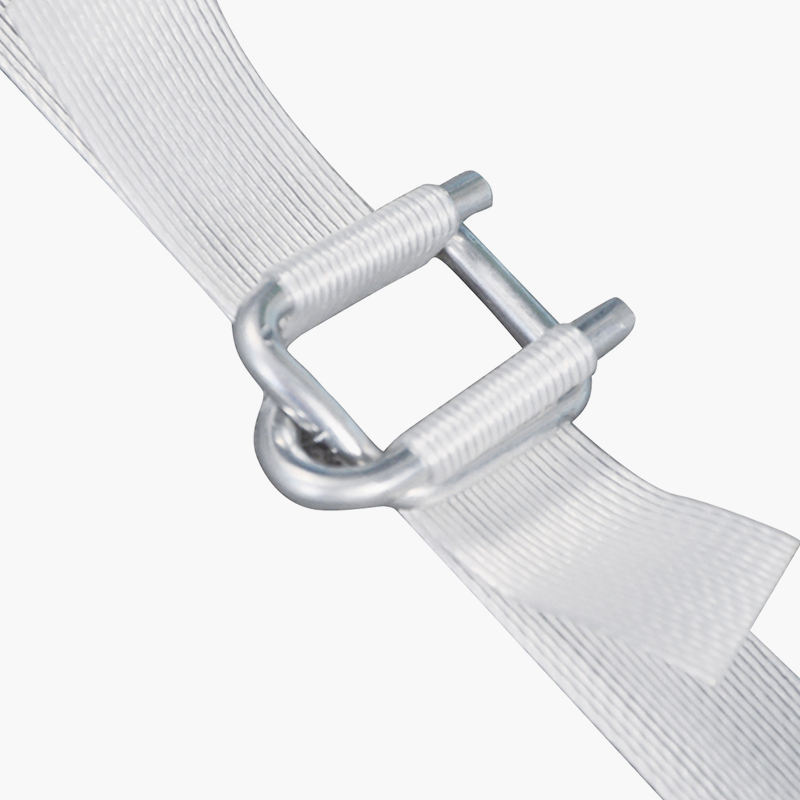
Joint efficiency defines the overall securement system. The strap is only as strong as the buckle holding it. If a strap has a linear strength of 1,000 kg but the buckle slips at 500 kg, the system strength is only 500 kg. The buckle must grip the strap tightly enough to prevent slippage, but not so tightly that it cuts through the polymer coating and severs the polyester yarns. When threading the strap, the operator must fold the strap, push it through the center of the buckle, and loop it over the prongs. If the wire gauge is too thin, the tension will pull the prongs inward, crushing the strap and causing immediate failure.
Specifying high-quality, galvanized 16mm wire buckles for strapping is required to prevent slippage. The wire gauge must match the strap thickness. The galvanization provides a textured grip that bites into the polymer coating without shearing it. Smooth buckles will slip. Undersized buckles will bend under tension.
Standard wire buckles suit most palletizing needs. Forged buckles are necessary for ultra-heavy lashing applications. Forged hardware withstands higher tension without deforming. Upgrading hardware is mandatory when securing oversized machinery or flatrack containers.
Strap Width
Buckle Type
Wire Gauge (mm)
System Strength (kg)
Ideal Application
13mm (1/2")
Standard Galvanized
3.0 - 3.3
~500 - 700
Light palletizing, carton bundling
16mm (5/8")
Heavy-Duty Galvanized
3.5 - 4.0
~850 - 1,050
Medium machinery, timber, pipes
19mm (3/4")
Heavy-Duty Galvanized
4.0 - 5.0
~1,200 - 1,500
Heavy construction materials, steel tubes
25mm (1")
Forged Steel
5.0 - 7.0
~2,000 - 2,500
Rail cargo, heavy machinery lashing
32mm (1 1/4")
Forged Steel
7.0+
~3,000+
Sea freight containers, oversized loads
Strapping Quality Assurance and Compliance Standards
Required Composite Strap Testing Documentation
Never rely on verbal strength claims. Demand mandatory testing reports before finalizing any bulk order. Request tensile strength tests, elongation tests, and joint efficiency reports. These documents prove the product performs under stress. A proper lab report will show the exact breaking point in decanewtons (daN) or kilograms (kg). It will also show the load-extension curve, which illustrates how the strap behaves as tension increases.
Third-party validation is necessary. Look for approvals from recognized bodies. AAR (Association of American Railroads) approval is mandatory for North American rail transit. DNV GL or SGS reports verify maritime compliance. Independent testing ensures the data provided by the composite strapping manufacturer is accurate and unbiased. Reviewing composite strap testing documentation protects your supply chain from liability. If a load shifts and causes an accident, investigators will ask for these certificates.
Factory Audits and ISO Certifications
A reputable manufacturer operates under strict quality management systems. ISO 9001 certification demonstrates consistent manufacturing processes. ISO 14001 certification indicates responsible environmental management. These are baseline requirements for global procurement. You want a partner who documents their procedures, calibrates their testing equipment, and tracks raw material batches.
Verify the authenticity of these certificates during the vendor vetting process. Cross-reference certificate numbers with issuing agencies. This is particularly important when sourcing from major global manufacturing hubs. Authentic strapping quality assurance protocols include raw material inspection, inline extrusion monitoring, and final batch testing. Ask the vendor for a video tour of their QA lab. Look for a melt flow index (MFI) tester. The MFI determines how the raw polypropylene behaves when heated. If the MFI is inconsistent, the coating thickness on the final strap will vary, creating weak spots. Look for universal testing machines (tensile testers) and environmental chambers used to simulate extreme weather.
Evaluating a Composite Strapping Manufacturer for Bulk Procurement
Production Capacity and Lead Time Consistency
Assess the overseas supplier’s manufacturing footprint. Count their active extrusion lines. Extrusion capacity dictates their maximum monthly output. Ask how they scale production during peak shipping seasons. Delays during Q3 and Q4 disrupt your entire outbound logistics schedule. A factory with only two lines will struggle to meet sudden volume spikes. A factory with ten lines offers much better reliability.
Evaluate the logistics of moving the product. Direct importing requires managing freight consolidation and customs clearance. It offers better unit economics for large volumes. Domestic warehousing provides buffer stock and faster emergency replenishment. Choose a manufacturer that aligns with your inventory strategy. Ask about their standard lead times for full container loads (FCL) versus less than container loads (LCL).
Customization and Traceability
Custom printing adds significant value. Printing company logos enhances brand visibility. Printing handling instructions improves safety at the receiving dock. More importantly, custom printing enables lot traceability. Printing batch numbers directly on the strap streamlines quality control and isolates potential defects. If a specific roll fails in the field, you can trace it back to the exact production shift and raw material batch.
Discuss options for specific lengths and coil sizes. Standardized coils fit common dispensers. Specialized applications may require longer continuous lengths to minimize reloading downtime. Inquire about UV-resistant additives for extreme outdoor storage scenarios. Some manufacturers can adjust the polymer blend to provide extra protection for lumber or pipe yards that store materials outside for months.
Red Flags in Vendor Selection
Watch for clear warning signs during the evaluation phase. Refusal to send physical samples indicates a broker, not a manufacturer. Inconsistent coil weights suggest poor extrusion control and varying coating thickness. Lack of in-house testing equipment means they cannot guarantee batch quality. If they have to send every sample to an outside lab, their inline quality control is likely non-existent.
Unusually low pricing is the biggest red flag. Producing high-tenacity polyester requires premium raw materials. Deep discounts suggest the use of recycled or low-grade polymers. Recycled polypropylene creates a brittle coating that shatters under tension or cold weather. It also fails to grip the wire buckle properly, leading to catastrophic slippage.
Implementation Risks and Mitigation Strategies
Operator Training and Tensioning Tool Calibration
Even the highest quality strap fails if applied improperly. Operator error is a primary cause of cargo securement failure. Leaving excessive slack before tensioning prevents the system from reaching optimal holding power. Incorrect threading through the wire buckle causes immediate slippage. The strap must pass through the buckle in a specific over-and-under pattern to create the self-locking friction mechanism.
Standardize your tensioning equipment. Use high-quality manual or pneumatic tensioners. Implement routine calibration checks. Tensioner gripper plates wear down over time. Worn plates slip against the polymer coating, preventing maximum tension. Replace worn parts immediately to maintain securement integrity. Train your dock workers to inspect the gripper foot daily. If the teeth look flat, the tool needs maintenance. Pneumatic tensioners require a clean, dry air supply. Moisture in the air lines will rust the internal components of the tensioner, leading to inconsistent tensioning force. Operators must oil pneumatic tools daily and drain the air compressor tanks to prevent water buildup.
Inventory Management and Storage Conditions
Proper storage prevents premature degradation. Keep bulk strapping in its original packaging until needed. Store coils indoors, away from prolonged direct sunlight. While the coating resists UV rays, constant exposure over years degrades the plastic. Dust and dirt can also coat the strap, reducing the friction needed for the buckle to grip properly.
Avoid extreme heat in warehouses. High temperatures can warp the plastic cores and soften the polymer jacket. Keep pallets off the ground to prevent moisture wicking into the cardboard boxes. Clean storage conditions ensure the strap performs exactly as tested when deployed. Implement a First-In, First-Out (FIFO) inventory system to ensure older stock gets used before new shipments.
Conclusion
Audit your current cargo securement failure rates to identify specific hardware or strap deficiencies on your loading dock.
Request a comprehensive sample kit from shortlisted manufacturers, ensuring it includes both the straps and the exact matching wire buckles.
Demand updated compliance certificates and third-party lab reports for your specific required strap width before signing any purchase orders.
Standardize your manual and pneumatic tensioning tools across all facilities and schedule a mandatory training refresher for your operators.
FAQ
Q: What is the difference between linear strength and system strength in composite strapping?
A: Linear strength is the breaking point of the strap alone when pulled from both ends. System strength includes the strap and the wire buckle joint working together. System strength is the true metric for cargo safety, as failures almost always occur at the joint, not the middle of the strap.
Q: How do I know if my 16mm wire buckles for strapping are compatible?
A: Buckles must match the strap width exactly. They must also possess the correct wire gauge and galvanization. The textured galvanized surface is required to grip the smooth polymer coating securely without cutting into the load-bearing polyester yarns under high tension.
Q: What testing documentation should a composite strapping manufacturer provide?
A: A reliable manufacturer will provide Tensile Strength Reports, Joint Efficiency Tests, and Elongation data. You should also request third-party certifications from recognized organizations like SGS, TÜV, or AAR approvals to validate their internal testing claims.
Q: Is composite cord strapping a viable replacement for steel banding?
A: Yes, it often replaces steel. Composite offers superior safety with no sharp edges, excellent shock absorption, and total corrosion resistance. However, steel banding maintains an advantage for specific rigid loads that require absolutely zero elasticity, such as hot-rolled steel coils.
Q: How does weather affect composite cord straps during transit?
A: High-quality polymer coatings protect the internal polyester yarns from moisture, chemicals, and UV rays. This prevents the rot, rust, and weight gain associated with traditional natural fibers or steel lashing, ensuring tension remains stable across diverse climates.
Q: What is the standard shelf life of wholesale composite cord strapping?
A: The standard shelf life is typically 1 to 2 years. Proper indoor storage extends usability significantly. Keep the coils in their original packaging, away from direct UV light, extreme heat, and heavy dust to maintain the integrity of the polymer coating.
Q: What is the difference between composite cord strapping and woven polyester strapping?
A: Composite strapping features a stiff polymer coating that provides superior abrasion resistance and makes it rigid enough to feed under pallets easily. Woven strapping lacks this coating, making it highly flexible but much more susceptible to fraying or cutting on sharp cargo edges.