
Views: 0 Author: Site Editor Publish Time: 2026-10-26 Origin: Site


Securing high-tonnage, irregularly shaped, or dynamic loads requires a precise balance of tensile strength, elongation recovery, and impact resistance. Selecting the wrong strapping material leads to load shifting during transit, compromised safety, increased product damage, and hidden inefficiencies in equipment maintenance or labor allocation. Standard polypropylene (PP) remains insufficient for these demanding applications. Heavy industrial environments require the superior tensile strength of PET, which provides approximately twice the strength of PP, or the extreme shock absorbency of composite cord. Evaluating composite cord strapping vs PET strapping requires looking beyond basic linear break strength. Facility managers must analyze system strength, application methodology, and long-term operational impact to ensure maximum load stability.
System Strength vs. Linear Strength: PET strapping relies on weld strength (friction or heat), whereas composite cord strapping achieves superior joint efficiency (system strength) through specialized wire buckles.
Dynamic vs. Static Loads: Composite cord strapping offers higher shock absorbency for loads that shift or settle, while PET strapping provides rigid, high-retained tension for static, uniform pallets.
Tooling and Scalability: PET strapping is highly scalable for automated or semi-automated high-volume lines; composite cord strapping requires manual application but demands significantly lower upfront tooling investment.
Safety and Ergonomics: Both synthetic options eliminate the laceration and whiplash risks associated with steel strapping, but they require different operator training protocols for safe tensioning.
Understanding the mechanical properties of strapping materials is the first step in optimizing heavy pallet load securing. Linear break strength defines the exact point of material failure under direct tension in a laboratory setting. Retained tension measures the ability of the strap to hold the load tightly over an extended period in the field. While linear strength prevents the strap from snapping during initial application, retained tension keeps the cargo stable during prolonged storage and transit.
Specific strap dimensions dictate these tensile limits. Industrial PET break loads typically range from 160 kg for lighter applications to over 1360 kg for heavy-duty specifications. Composite cord strapping offers comparable or even higher break strengths depending on the yarn density and width. Elongation and elastic recovery play massive roles in compensating for load settling. When securing timber that dries and shrinks, or corrugated boxes that compress under weight, the strapping must contract to maintain tension. Materials with high elastic recovery prevent bands from hanging loose after the load dimensions change.
To properly evaluate a load profile before selecting a strapping material, operators should follow a systematic assessment:
Measure the maximum static weight of the fully loaded pallet.
Identify the primary transit mode (rail, sea, over-the-road) to gauge expected dynamic forces and vibration levels.
Determine if the load materials will settle, shrink, or expand during transit due to moisture loss or compression.
Assess the operating environment for extreme temperatures, UV exposure, or chemical presence.
Calculate the required throughput speed to determine if manual or automated application is necessary.
A strapping system is only as strong as its weakest point, which is almost always the joint. The securing mechanism dictates the actual failure point of the strap. Friction welds, heat seals, and metal buckles all perform differently under stress. System strength represents the true holding power of the applied strap, calculated by multiplying the linear break strength by the joint efficiency percentage.
Evaluating joint efficiency is a mandatory metric for heavy industrial applications. A strap with a 1000 kg break strength and a 50% joint efficiency will fail at 500 kg of applied force. PET systems relying on friction welds typically achieve 70% to 80% joint efficiency when tools are perfectly calibrated. Wire buckle systems used with composite cord can achieve up to 90% joint efficiency, providing a higher functional system strength even if the linear break strength appears similar on paper.
Strapping materials face severe environmental degradation and dynamic transit forces once they leave the loading dock. UV exposure degrades unprotected polymers, causing them to become brittle and snap under tension. Moisture compromises certain materials, leading to rust on metal components or weakening of inferior synthetic fibers. Temperature fluctuations cause expansion and contraction, testing the elastic recovery of the strapping.
Dynamic transit forces introduce kinetic energy into the load. Rail car shunting generates massive, instantaneous shock loads that test the absolute limits of joint efficiency. Rough seas cause continuous swaying and vibration over weeks of transit. Strapping materials must either possess the rigidity to prevent any movement or the elasticity to absorb the shock and return to their original position without breaking.
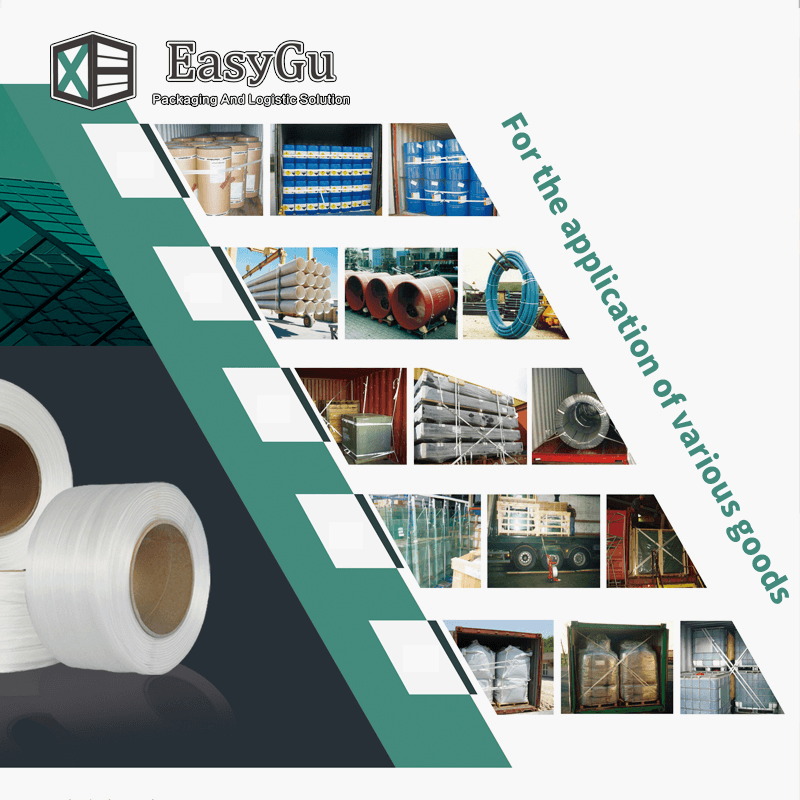
Extruded polyester packing straps feature a highly aligned molecular orientation. This manufacturing process creates a rigid, high-tensile material frequently utilized as a direct replacement for steel banding. The structural rigidity prevents the strap from stretching excessively under heavy loads, ensuring the cargo remains tightly bound in a static position.
PET exhibits low elongation and high retained tension. These characteristics make it the ideal choice for rigid, uniform loads that do not shift or compress during transit. When securing concrete blocks, metal ingots, or tightly packed beverage cans, the strap must hold the items in a strict, immovable formation. Procurement teams must select PET based on exact dimensional specifications and coil presentation rather than relying on color. The physical dimensions, surface embossing, and resin quality dictate performance, making visual color indicators irrelevant to structural integrity.
Applying PET strapping efficiently requires specialized equipment. Operators rely on friction-weld battery-operated tools, pneumatic tensioners, or fully automated strapping arches. Battery-operated tools tension the strap, friction-weld the joint, and cut the excess material in a matter of seconds. The friction welding process works by vibrating the two strap ends against each other at high speeds, melting the polymer, and then holding it under pressure until it cools and fuses.
This reliance on mechanical application introduces specific maintenance requirements. Friction wheels wear down over time and require regular replacement. Battery health must be monitored to ensure consistent weld times. Pneumatic tools require clean, lubricated air lines to function correctly. Facilities must allocate resources for routine tool calibration and preventative maintenance to prevent weld failures.
PET Tool Component | Maintenance Action | Inspection Frequency |
|---|---|---|
Friction Wheel / Gripper | Clean debris, check for tooth wear, replace if slipping | Weekly |
Cutter Blade | Inspect for dullness, replace if strap frays during cut | Monthly |
Battery Contacts | Clean oxidation, ensure secure connection | Monthly |
Tension Motor | Check calibration, ensure consistent pulling force | Quarterly |
PET strapping excels in specific operational environments. High-volume manufacturing facilities benefit immensely from the speed of automated PET systems. Automated logistics hubs rely on PET to maintain throughput rates. Uniform block stacking and static heavy loads, such as bricks, aluminum ingots, and lumber, represent the optimal use cases for this rigid material.
Adopting PET carries inherent risks in the wrong applications. Weld failure remains a primary concern under severe shock loads. If a forklift drops a pallet or a railcar shunts violently, the rigid nature of PET transfers the kinetic energy directly to the weld, potentially causing it to pop. Extruded polyester can also split longitudinally if nicked or cut on a sharp edge, compromising the entire strap.
Composite cord strapping utilizes a co-extruded manufacturing process. High-tenacity polyester yarns run parallel down the length of the strap, providing massive linear strength. These yarns are entirely embedded in a protective polymer coating. This structural design creates a material that is exceptionally flexible while maintaining high tensile limits.
The flexibility translates directly into superior shock absorption. When a dynamic load shifts, the composite cord stretches slightly to absorb the kinetic energy, preventing the strap from snapping. The polymer coating provides excellent abrasion resistance, protecting the internal load-bearing yarns from sharp edges, rough concrete, and transit friction. This makes it highly effective for securing rough-cast metals or machinery with irregular geometries.
Composite cord relies entirely on a self-locking wire buckle system to secure the joint. When tension is applied, the wire buckle bites down on the strap. The harder the load pulls, the tighter the buckle grips. This mechanical action creates a joint efficiency of up to 90%, significantly higher than most friction welds.
Achieving this efficiency requires matching the hardware perfectly to the strap. Utilizing 25mm wire buckles for composite straps is mandatory when deploying a 25mm heavy duty composite cord strap. If the buckle gauge is too thin, it will deform under tension. If the buckle is too narrow, the strap will bunch and slip. Proper hardware selection dictates the final system strength.
Proper threading technique is required to achieve maximum joint efficiency. Operators should follow these steps:
Fold the strap to create a loop and push it up through the center of the wire buckle.
Slip the loop over the front prong of the buckle and pull the slack tight.
Take the other end of the strap, create a second loop, and push it up through the center of the buckle.
Slip this second loop over the rear prong of the buckle.
Apply the manual tensioner to the bottom strap and crank until the desired tension is reached, ensuring the strap sits flat against the wire.
Composite cord strapping is the definitive choice for challenging loads. Export shipping, out-of-gauge cargo, and heavy machinery require the shock absorbency and high system strength that composite provides. Chemical drums and loads that expand or contract during transit benefit from the material's elastic recovery and flexibility.
The primary adoption risk involves application speed. Composite cord requires a manual application process. Operators must manually thread the buckle, apply a mechanical tensioner, and cut the strap. This reliance on operator skill introduces the risk of improper buckle threading, which can lead to joint failure. The manual nature of the process makes it less suitable for high-speed automated packaging lines where pallets move down a conveyor every few seconds.
The fundamental difference between these materials lies in how they handle kinetic energy. PET strapping resists movement rigidly. It attempts to hold the load static through sheer tensile strength. Under extreme impact, this rigidity can cause the strap or the weld to fail because the energy has nowhere to go. Composite cord strapping absorbs kinetic energy. It elongates slightly under impact, dissipating the force before returning to its original tension. This makes composite cord vastly superior for dynamic loads that shift during transit, such as heavy equipment on a flatbed truck.
Evaluating these systems requires analyzing the balance between equipment infrastructure and labor time. PET strapping systems require battery-operated tools or automated arches. The operational labor time per pallet is extremely low, allowing a single operator to secure dozens of pallets an hour. Composite cord strapping systems utilize simple, manual tensioners. The trade-off is higher labor time per pallet due to the manual threading and tensioning process.
Ergonomics play a major role in daily operations. Battery-operated PET tools can weigh several kilograms, leading to operator fatigue during continuous manual use on the side of a pallet. Manual tensioners for composite cord are lighter but require physical exertion to crank the handle and achieve maximum tension.
Both materials offer excellent weather resistance compared to steel. PET incorporates UV inhibitors during the extrusion process, allowing it to withstand prolonged outdoor storage. It is entirely impervious to moisture and will not rust. Composite cord also resists moisture and UV degradation. The distinct advantage of composite cord lies in its polymer coating, which provides superior protection against chemical exposure and severe abrasion on rough terrain.
Evaluation Metric | PET Strapping | Composite Cord Strapping |
|---|---|---|
Joint Mechanism | Friction Weld / Heat Seal | Galvanized Wire Buckle |
Joint Efficiency | 70% - 80% | Up to 90% |
Shock Absorption | Low (Rigid) | High (Elastic Recovery) |
Ideal Load Type | Static, Uniform, Rigid | Dynamic, Irregular, Settling |
Application Method | Battery Tool / Automated Arch | Manual Tensioner |
Establishing a framework for operational efficiency requires analyzing all material and labor inputs. Facility managers must calculate the meterage of strap used per pallet, the consumption rate of wire buckles or friction-weld seals, the lifespan of the application tools, maintenance intervals, and the labor time required per unit.
The break-even point between manual and automated systems depends entirely on volume. Low-volume operations shipping heavy, irregular machinery benefit from the simplicity of composite cord. High-volume operations wrapping hundreds of uniform pallets daily justify the infrastructure of automated PET systems through massive reductions in labor time. Wasting five minutes manually strapping a pallet is acceptable for a custom-built generator, but unacceptable for a pallet of bottled water.
Scaling up operations requires evaluating the logistical footprint of the chosen material. Industrial cargo packaging solutions must adapt to increased throughput without causing bottlenecks. PET strapping scales easily through automation. Upgrading from battery tools to automated arches instantly multiplies throughput capacity without adding headcount.
Scaling composite cord operations requires adding more manual labor and workstations. Facility managers must also consider storage footprints. PET coils are dense and heavy, requiring specific dispensing carts to move around the warehouse. Composite cord coils are lighter and easier to handle, but operations must also allocate storage space and inventory tracking for boxes of wire buckles.
Successful implementation relies heavily on operator training. PET strapping requires technical training on tool operation. Operators must learn how to calibrate tension settings, inspect friction welds for proper fusion, and manage battery charging cycles. A poorly calibrated tool produces weak welds that look fine to the naked eye but fail during transit.
Composite cord requires mechanical training. Operators must master the correct tensioning techniques to avoid over-stressing the manual tools. They must learn how to prevent buckle slippage by ensuring the strap sits flat within the wire frame. Proper threading of the buckle is the most critical training component; an incorrectly threaded buckle provides zero joint efficiency and guarantees load failure.
Moving away from steel banding requires careful change management. Operators accustomed to steel often mistrust synthetic materials initially. Highlighting the ergonomic and operational benefits accelerates adoption. Synthetic coils, particularly PET, are up to 50% lighter than equivalent steel coils. This weight reduction enables safer, one-person operation and significantly reduces workplace fatigue.
Mitigating early-adoption errors keeps the transition smooth. Operators transitioning to PET often over-tension the strap, attempting to replicate the rigidity of steel, which can crush corrugated packaging or damage product edges. Operators transitioning to composite cord often under-tension the strap, failing to engage the self-locking mechanism of the buckle fully. Supervised transit trials and drop tests help calibrate operator technique during the transition phase.
PET strapping stands as the superior choice for high-volume, uniform, static loads requiring automated application. Its rigidity and high retained tension keep block-stacked pallets secure. Conversely, composite cord strapping is the definitive solution for dynamic, irregularly shaped, or heavy export loads requiring maximum shock absorption and superior joint efficiency.
When shortlisting materials, base the decision matrix on load type, throughput volume, and equipment availability. Static loads with high throughput demand PET. Dynamic loads with lower throughput or irregular shapes demand composite cord.
Audit your current load profiles to identify instances of load settling, expansion, or transit damage that require high elastic recovery.
Conduct a controlled transit trial using both materials to evaluate real-world performance under dynamic forces like rail shunting.
Perform drop tests to validate the joint efficiency of friction welds versus wire buckles on your specific load types.
Request vendor demonstrations to assess the ergonomic impact of battery tools versus manual tensioners on your workforce.
A: Linear break strength measures material failure, where PET ranges up to 1360+ kg depending on dimensions. System strength is more critical. While PET offers high linear strength, composite cord paired with wire buckles yields higher joint efficiency (up to 90%), providing superior functional strength under heavy shock loads.
A: Yes, manual tensioners and serrated metal seals exist for PET. However, PET is highly optimized for battery-operated friction weld tools or automated machines. Manual application of PET significantly reduces joint efficiency and negates the speed advantages of the material.
A: The buckle gauge and width must perfectly match the heavy duty composite cord strap. Using an undersized or improperly gauged buckle causes the metal to deform under tension, leading to strap slippage and catastrophic failure of the rated system strength.
A: Both materials perform exceptionally well outdoors compared to steel. PET contains UV inhibitors that prevent degradation from sunlight. Composite cord features a protective polymer coating that resists UV rays, moisture, and offers superior abrasion resistance on rough terrain.
A: Yes. It provides equivalent system strength with superior shock absorbency. It eliminates severe safety hazards associated with steel, such as lacerations and whiplash upon cutting. The lighter coil weights also enable safer, one-person operation.
A: Evaluate the dynamic transit forces, such as rough seas or rail shunting, and maritime moisture exposure. Composite cord is often preferred for export due to its shock absorption, rust resistance, and the ease with which receivers can safely cut and dispose of the material.