
Views: 0 Author: Site Editor Publish Time: 2026-10-15 Origin: Site


Dynamic cargo shifts during intermodal transit create massive financial and operational stakes. When a 20-ton load shifts inside a corrugated box, the results are immediate. Product damage, port rejections, and liability claims routinely disrupt supply chains. Procurement and logistics teams struggle to balance load security with operational efficiency. They frequently over-specify steel banding, which introduces severe safety risks, or under-specify standard PET, which lacks the necessary tensile strength. This mismatch leads to dangerous safety hazards or compliance failures at the port. You need a highly engineered alternative that handles dynamic shock effectively. Implementing composite cord strapping for containers solves these mechanical challenges. Successful adoption requires strict evaluation. You must assess system strength, buckle compatibility, and supplier reliability to ensure your cargo arrives intact.
System strength—not just linear break strength—dictates the true securing capacity of composite cord straps; the strap and buckle must be evaluated as a single unit.
Selecting the correct wire buckles for composite strapping (galvanized vs. phosphated) is non-negotiable for preventing slippage under heavy dynamic loads.
Compliance with international container cargo securing standards (e.g., CTU Code, AAR, IMO) requires verifiable batch testing and certified Maximum Securing Load (MSL) ratings.
Evaluating a composite strapping supplier should prioritize technical support, on-site training capabilities, and transparent quality control data over unit cost alone.
A successful container load securing solution requires zero load shift during transit. It demands worker safety during application, rapid deployment on the loading dock, and strict regulatory compliance. Traditional materials often fail one or more of these criteria. Modern polymer engineering provides a superior alternative designed specifically for the extreme forces of intermodal transport.
Steel banding provides rigid tension but lacks elastic elongation and recovery. When heavy cargo shifts during transit, steel cannot stretch. It hits its yield point and snaps under sudden impact. Polyester composite strapping for heavy cargo offers high tensile strength combined with elastic memory. It stretches slightly under a dynamic load and returns to its original tension once the force dissipates.
Safety during application and removal heavily favors composite materials. Steel bands store massive kinetic energy when tensioned. Cutting steel creates a dangerous whiplash effect, exposing workers to severe laceration risks. Composite straps cut cleanly and safely with standard safety knives. They fall to the ground without recoil, protecting warehouse personnel.
Cargo damage remains a constant threat with steel. Steel bands rust rapidly during ocean transit, staining packaging and products. They also cause severe abrasion on painted or fragile surfaces. Composite straps feature a non-abrasive polymer coating. This coating protects the cargo while maintaining high tension, eliminating the need for extensive protective padding in many applications.
Containers endure violent dynamic shocks across different transport modes. Rail shunting generates massive longitudinal forces when cars couple. Ocean swells create constant lateral swaying and pitch. Hard braking on highways causes sudden forward momentum. Rigid securing materials fail under these dynamic loads because they cannot absorb the energy.
Composite straps absorb and dissipate kinetic energy efficiently. They consist of parallel polyester yarns encased in a clear polymer coating. The high-tenacity yarns provide the core strength, while the coating keeps the yarns aligned and protects them from friction. When a container hits a rail yard bumper, the strap elongates by 4% to 8%. It absorbs the shock without snapping. Once the kinetic energy dissipates, the strap recovers its tension. This continuous shock absorption prevents catastrophic load failures.
Strapping rarely works alone. It interacts with other securing materials inside the container. You must integrate composite straps into comprehensive container load securing solutions. A unified cargo block prevents all movement across all axes.
Follow these steps to integrate composite strapping with other securing materials:
Position high-friction rubber mats under heavy machinery to increase the friction coefficient and reduce the required securing force.
Apply edge protectors where straps meet sharp cargo corners to prevent localized abrasion and maintain full structural integrity.
Route the composite straps through the container's designated lashing rings, ensuring the angle of the strap does not exceed 45 degrees relative to the floor.
Tension the straps using a specialized windlass tensioner until the cargo is firmly anchored to the floor or walls.
Deploy dunnage air bags in the lateral voids between the cargo and the container walls to prevent side-to-side movement.
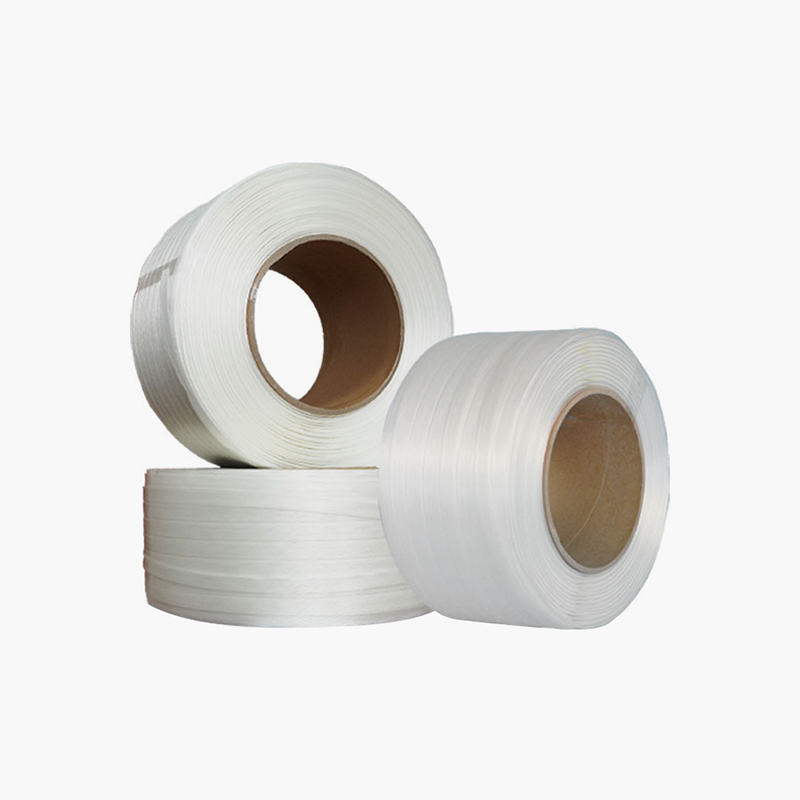
Physical product specifications map directly to load-securing performance. You must evaluate the entire system rather than isolated components. Relying on isolated metrics provides a false sense of security and leads to field failures.
Linear Break Strength measures the force required to break the strap alone. It ignores the joint entirely. System Strength measures the force required to break the strap when joined by a buckle. The joint is always the weakest link in any strapping application.
Procurement must mandate System Strength data. Container cargo securing calculations rely on the joint's holding power. A strap with high linear strength but a weak buckle will fail under pressure. System strength dictates the actual working capacity of your securing setup.
Metric | Definition | Testing Method | Relevance to Load Securing |
|---|---|---|---|
Linear Break Strength | Force required to snap the strap without a joint. | Pulling a single continuous piece of strap until failure. | Low. Does not reflect real-world application where a buckle is always used. |
Joint Efficiency | Percentage of linear strength retained at the buckle. | Comparing system strength to linear break strength. | High. Indicates how well the buckle grips the specific strap coating. |
System Strength | Force required to break the strap and buckle assembly. | Pulling a looped strap secured by a wire buckle until failure or slippage. | Critical. This is the exact metric used to calculate Maximum Securing Load (MSL). |
The joint mechanics dictate system reliability. The buckle geometry locks the strap under tension. As tension increases, the buckle bites harder into the strap. You must select the correct wire buckles for composite strapping to ensure this mechanical lock holds.
Buckle finishes determine friction levels. Galvanized buckles suit standard environments and lighter loads where extreme tension is not required. Phosphated buckles feature a rough, textured chemical conversion coating. This texture grips the polymer coating aggressively. Phosphated buckles are mandatory for heavy or dynamic loads because they prevent slippage under extreme stress.
Wire gauge must match strap thickness perfectly. If the wire is too thin, it will deform and bend under the torque of the tensioner. The joint will slip immediately. If the wire is too thick, the tensioner cannot pull the strap through the buckle efficiently, resulting in a loose load. Exact matching ensures maximum joint efficiency.
Shipping containers experience extreme temperature fluctuations during global transit. This creates container rain, where condensation drips continuously onto the cargo. Steel rusts rapidly in these conditions, losing structural integrity and staining the product. Composite strapping remains completely unaffected by moisture, maintaining its full tensile strength even when submerged.
Flat rack containers and open-top cargo expose straps to direct sunlight. UV radiation degrades standard plastics, causing them to become brittle and snap. High-quality composite straps contain specialized UV inhibitors mixed into the polymer coating. They maintain their flexibility and tensile strength during long ocean voyages under direct sun exposure.
Industrial solvents and marine environments break down inferior materials. The polymer coating on composite straps offers excellent chemical resistance. It withstands exposure to oils, acids, alkalis, and saltwater. This ensures reliable performance across diverse transport routes, from chemical plants to offshore oil rigs.
Confined spaces complicate cargo securing. Threading straps at the rear doors of a fully loaded 40ft container is difficult and physically demanding. Composite strapping offers superior flexibility compared to rigid steel. Workers can easily route it through tight gaps, over bulky machinery, and through narrow lashing rings without fighting the material.
Cold-weather environments pose significant challenges for logistics teams. Standard plastics become brittle and crack under tension. Steel becomes dangerously rigid and difficult to manipulate with heavy gloves. Composite strapping maintains its flexibility in sub-zero temperatures. Workers can handle, thread, and tension the material safely and efficiently in harsh winter conditions.
Categorize and select specific strap dimensions based on cargo weight and transport mode. Using the wrong size compromises safety, violates shipping regulations, and wastes material.
Maximum Securing Load (MSL) dictates your hardware requirements. Calculate MSL based on cargo mass, friction factors, and the specific transport mode. Different transport modes generate different dynamic forces, requiring different securing capacities.
A standard rule of thumb applies for intermodal transport. The combined MSL of all straps must equal a specific percentage of the cargo weight. For ocean freight, securing force often needs to match the total cargo weight. For rail transit, longitudinal forces require even higher securing capacities, sometimes up to 1.5 times the cargo weight. Always factor in the friction coefficient of the cargo against the container floor. A wooden crate on a wooden floor requires less securing force than a metal skid on a metal floor.
Strap width determines load capacity. Select the width based on the specific application and the calculated MSL. Composite cord straps come in various sizes to accommodate different cargo profiles.
Strap Width | Typical System Strength (daN) | Buckle Type Required | Primary Container Application |
|---|---|---|---|
13mm (1/2") | 300 - 400 | Galvanized | Light carton consolidation, internal bundling |
16mm (5/8") | 450 - 600 | Galvanized / Phosphated | Light pallets, drum securing, medium crates |
19mm (3/4") | 750 - 1,000 | Phosphated | Chemical drums, heavy crates, automotive parts |
25mm (1") | 1,100 - 1,500 | Heavy-Duty Phosphated | Machinery, IBC tanks, timber bundles |
32mm (1 1/4") | 1,600 - 2,300+ | Heavy-Duty Phosphated | Steel coils, heavy pipes, flat racks, generators |
Strap width and cargo volume impact your choice of tensioning tools. Standard PET tools cannot grip the polymer coating of composite straps. You need specialized equipment designed specifically for cord strapping.
Manual windlass tensioners work well for low-volume applications. They are highly portable and ideal for remote loading sites without power. The operator threads the strap through the windlass and cranks the handle to achieve the desired tension. Pneumatic or battery-operated tensioners are necessary for high-volume operations. They provide consistent, measurable tension across every strap. They reduce operator fatigue when securing multiple heavy loads daily and ensure uniform load distribution.
Utilizing uncertified securing materials introduces massive regulatory and liability risks. Port authorities will reject non-compliant containers, causing severe delays. Insurance companies will deny claims for improper securing if the materials lack proper certification.
The IMO/ILO/UNECE Code of Practice for Packing of Cargo Transport Units (CTU Code) governs international shipping. It mandates specific securing practices, lashing angles, and material strengths. Your container cargo securing strategy must align strictly with these guidelines to pass port inspections.
North American intermodal transit requires Association of American Railroads (AAR) approval. AAR testing simulates violent rail shunting on impact tracks. Only AAR-approved strapping systems can travel on North American rail networks. Verify these approvals before loading any container destined for rail transport.
Never rely solely on manufacturer marketing claims. Demand third-party testing documentation. Organizations like DNV GL and TÜV Rheinland provide independent verification of system strength and environmental resistance.
Read the certification certificate carefully. Ensure it applies to the exact strap-and-buckle combination you are purchasing. A certificate for a 32mm strap is invalid if you use a different buckle brand or a lighter wire gauge. The certification must cover the complete joint assembly as it will be used in the field.
Modern procurement requires strict waste management protocols. End-of-life disposal impacts your environmental footprint and operational efficiency at the receiving facility. Disposing of sharp steel banding poses severe laceration hazards to waste handlers. Steel requires specialized recycling streams and takes up massive volume in dumpsters.
Polymer-coated polyester waste is much safer to handle. It rolls up compactly, taking up significantly less space in waste receptacles. Many industrial recycling programs now accept composite strapping. This reduces landfill impact, lowers disposal fees, and aligns with corporate sustainability goals.
Auditing suppliers requires looking beyond the initial price per coil. A cheap strap that fails in transit costs exponentially more in damaged goods and lost reputation than a premium strap that holds the load securely.
Manufacturing defects compromise load security instantly. Look for visual red flags during your evaluation. Inconsistent polymer extrusion creates weak spots that snap under tension. Uneven yarn distribution causes the strap to split longitudinally. The coating must be smooth, uniform, and completely encase the internal yarns.
Require your composite strapping supplier to provide Certificates of Analysis (CoA). Demand batch-specific tensile testing reports. A reliable manufacturer tracks every coil back to its original raw material batch. They test samples from every production run to guarantee consistency.
A supplier must provide more than just strapping. They must supply high-quality tensioners and heavy-duty dispensers. Using incompatible tools damages the strap coating and reduces system strength. A poor-quality dispenser allows the coil to telescope and tangle, ruining warehouse productivity.
Evaluate the availability of training. Warehouse staff need instruction on correct threading and tensioning techniques. A reversed buckle reduces system strength by over 50%, virtually guaranteeing a load failure. Suppliers should offer on-site or virtual training programs. Proper implementation prevents catastrophic failures and ensures your team uses the material correctly.
Conduct a direct cost-per-load analysis. Calculate material cost, labor speed, and damage reduction. Composite strapping applies faster than steel, reducing labor hours per container. It eliminates rust and abrasion damage, lowering insurance claims. These operational efficiency gains justify the investment to stakeholders.
Analyze the hidden costs of cheap strapping. Cheap materials cause constant re-work on the loading dock. They lead to damaged goods and slow application times. A broken strap requires unloading and reloading the entire container. Evaluate supplier inventory depth and check their lead times. You must prevent packaging bottlenecks during peak shipping seasons by partnering with a supplier who maintains robust stock levels.
Composite cord strapping remains the optimal choice for heavy, dynamic container loads. When engineered and applied correctly, it outperforms steel in safety, shock absorption, and ease of use, ensuring your cargo reaches its destination intact.
Follow a strict shortlisting logic. Calculate your required MSL first based on cargo weight and transport mode. Select the necessary System Strength based on that calculation. Match the strap width to a heavy-duty phosphated buckle. Finally, verify all independent certifications to ensure compliance.
Take immediate action to upgrade your securing process:
Audit your current cargo damage rates to identify specific failure points in your existing strapping methods.
Request sample coils and phosphated buckles for pilot testing on your heaviest, most challenging loads.
Demand verifiable system strength documentation and batch testing reports from prospective suppliers before signing any contracts.
Schedule an on-site training session for your loading crew to ensure proper buckle threading and tensioning techniques.
A: Composite cord straps feature parallel polyester yarns encased in a clear polymer coating. This coating provides high abrasion resistance and rigidity. Woven strapping consists of an exposed cross-weave of yarns without a stiff coating. Composite is easier to thread under pallets, while woven is softer but more susceptible to fraying.
A: Yes. Heavy-duty composite strapping offers system strengths exceeding 2,000 daN. It easily secures heavy machinery. Unlike steel, composite strapping absorbs dynamic shocks during transit without snapping, making it a safer and more reliable alternative for heavy loads.
A: You must match the buckle wire gauge to the strap width and thickness. For heavy or dynamic loads, always select phosphated finishes. The textured surface of a phosphated buckle grips the polymer coating aggressively, preventing joint slippage under high tension.
A: MSL varies entirely by strap width and the specific buckle pairing. A 16mm strap might offer an MSL of around 450 daN, while a heavy-duty 32mm strap paired with a thick-gauge phosphated buckle can exceed 1,600 daN per strap.
A: Yes. You need specialized manual windlass tensioners or pneumatic tensioners designed for cord strapping. Standard PET or steel banding tools cannot grip the polymer coating. You also need heavy-duty dispensers to manage the coils efficiently.
A: Yes. While the polymer coating is non-abrasive and will not damage your cargo, sharp cargo edges can cut the strap. Edge protectors shield the strap from sharp metal corners, ensuring the system maintains its maximum strength.
A: Yes, provided you select a certified brand. The strapping system must carry relevant third-party certifications like DNV GL or AAR approvals. Furthermore, your loading crew must apply the straps in strict accordance with the CTU Code guidelines.